
Redefining What’s Possible in High-Temperature Materials Testing
Materials Research Furnaces (MRF) and University of Arizona’s Material Science and Engineering Program Announce Collaboration in Advanced Material Testing
Allenstown, NH — Materials Research Furnaces (MRF) is partnering with the University of Arizona’s Department of Materials Science and Engineering to develop a high-temperature, high-vacuum physical testing furnace. Engineered for precise atmosphere control, the system achieves an ultimate vacuum of 10⁻⁶ Torr and temperatures up to 2000 °C, enabling researchers to gain critical insights into the mechanical behavior of advanced materials.
The new furnace will support pioneering research in hypersonic flight, defense technologies, and additive manufacturing—marking a major step forward in high-temperature materials science and next-generation aerospace innovation.
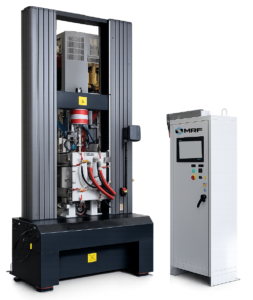 Equipped for both tensile and compression testing, this state-of-the-art system will accelerate the development of materials capable of withstanding extreme environments. With advanced thermal control and mechanical precision, it will enable breakthroughs in high-performance metallic alloys and other materials essential for the future of flight.
“We are excited to join forces with the University of Arizona’s Department of Materials Science & Engineering — a team renowned for transforming cutting-edge materials science into real-world aerospace breakthroughs,” said Chuck Miller, President MRF. “By integrating our advanced furnace-processing capabilities with their deep expertise in high-temperature metallic alloys, composites and extreme-environment ceramics, we are poised to accelerate the development of next-generation aerospace solutions.”
The University of Arizona has expressed interest in broadening access to its physical testing furnace, allowing organizations in the hypersonic, defense, and advanced materials sectors to utilize the system during periods when it is not in academic use. This initiative underscores the university’s commitment to strengthening collaboration between academia and industry to drive research and technological advancement. The system is scheduled to be fully functional in Q3 of 2026.
The collaboration reflects the University of Arizona’s dedication to fostering industry partnerships that fuel research and innovation. “We’re thrilled to bring this new system online—it’s going to be a true workhorse for advanced materials research,” said Sammy Tin, Department Head of Materials Science and Engineering and Patrick R Taylor Professor at the University of Arizona. “It provides the foundation to gather meaningful data that will drive material optimization, and we’re eager to make these resources available to the broader industry.”
About Materials Research Furnaces (MRF) MRF is a global leader in precision thermal systems essential for the production, development, and research of advanced materials. These advanced materials include carbon-carbon composites, ceramic matrix composites (CMC’s), advanced ceramics, materials for nuclear power and semiconductor applications. For decades, we have pioneered some of the world’s most innovative, customized furnace systems, with a focus on enabling the processing of materials with precision at high temperature in controlled atmospheres or vacuum.
About the University of Arizona’s Department of Materials Science and Engineering
The University of Arizona’s Department of Materials Science and Engineering is dedicated to making the stuff that makes the future. In an era of big data and growing global challenges, The University of Arizona brings together cutting-edge research and hands-on learning across disciplines — from phonons for quantum computing to ceramics built for outer space.
The Material Science and Engineering program is recognized for its industry-relevant curriculum, world-class faculty, entrepreneurial mindset, small class sizes, and modern research facilities. Students and researchers alike engage in a collaborative, multidisciplinary environment designed to solve real-world problems and advance technologies that shape the world — preparing graduates for leadership in high-tech industries, research institutions, and beyond.
Media Contact:
Cheryl Paiva
Marketing Specialist
E-mail: Cpaiva@mrf-furnaces.com
 nstown, NH — Materials Research Furnaces (MRF), a global leader in high-temperature furnace technology, is proud to announce an exciting new partnership with the University of South Carolina’s McNair Aerospace Center. Together, MRF and the McNair Center are establishing a cutting-edge precision ultra-high-temperature furnace system capable of 2400°C operation. This advanced furnace system, featuring an approximately 8ft³ usable hot zone, represents a significant leap forward in materials processing technology.
 2020
2020